
Disaster Risk Management
Instructor: Andreas Siebert
Credit: European Union, Copernicus Sentinel-2 imagery
A series of assignments within the "Disaster Risk Management" course (summer semester 2023) of the MSc Applied Geoinformatics programme that dealt with different methods and approaches for managing natural and manmade disasters, from the prevention phase to the recovery.
#1-International Risk Expert
In this assignment, the potential of country wide risks was analysed by first identifying the risks and then searching for different data and resources to assist at the different stages of disaster management. Greece was selected for this case study and different risks, like hydrological, geological and atmospheric were considered and different resources were examined.

#2-National Civil Protection Manager
In this assignment, the goal was to improve the national disaster control of a chosen country by calculating the expected number of affected people after a (hypothetical) natural disaster.
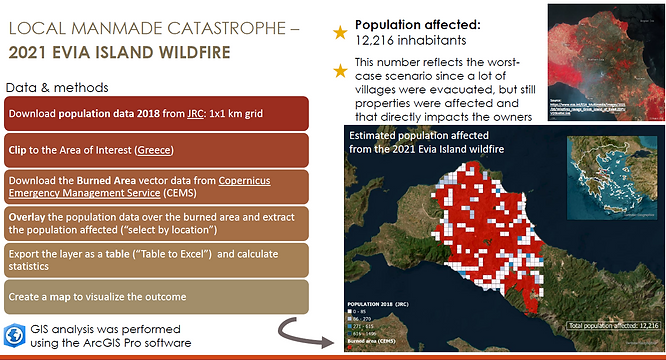
Greece was chosen again as a case study and, using different data like population and CEMS, the affcted population was evaluated for two different disasters, a a (local) man-made catastrophe (ca. 100 sqkm) and a regional natural catastrophe (ca. 10.000 sqkm). A wildfire in Evia Island and the medicane "Ianos" were chosen as case studies.
#3-National Financial Advisor
In the final assignment, after having calculated the affected population by two disasters of different scale in Greece, the goal is to calculate the (monetary) economic loss of these two scenarios. For that, public data of total estimated damages ($) were utilized together with geographic data from the affected areas.
