Intercomparison of chlorophyll-a concentration estimation models in inland waters using Sentinel-2 MSI satellite imagery: a case study of Lake Balaton and Lake Geneva
Supervisor: Associate Professor Dirk Tiede
Master's thesis
Credit: European Union, Copernicus Sentinel-2 imagery
Access the full document here:
Abstract
Water quality monitoring is essential for preserving aquatic ecosystems, which not only hold
ecological importance but also provide valuable services to humans. Chlorophyll-a (chl-a) is a
key water constituent that serves as an indicator of phytoplankton biomass, primary production,
trophic status, and the overall health of water bodies. Earth Observation satellite data are broadly
used to monitor the water quality of inland and coastal waters. Over the past decades, several
models have been developed to estimate the chl-a concentration in aquatic environments from
different satellite sensors. Due to the optical complexity of those environments and the influence
of the atmosphere on the signal received by the satellite sensors, multiple atmospheric
correction processors have been specifically designed for retrieving the water-leaving
reflectances, which form the basis for performing reliable water quality assessments. This study
aims to evaluate the performance of three widely used chl-a concentration estimation models,
the OC2, OC3, and MDN, applied to Sentinel-2 MSI Level-1C satellite imagery over two European
lakes with distinct optical and physical characteristics, Lake Balaton and Lake Geneva.
Atmospheric correction was performed using the ACOLITE and C2RCC processors, which were
selected based on their applicability to similar environmental conditions. In situ Remote Sensing
Reflectance (Rrs) and chl-a concentration measurements were obtained to evaluate the
performance of the atmospheric correction and the chl-a concentration models. ACOLITE
achieved moderate accuracy for Lake Balaton, while C2RCC performed well for Lake Geneva. The
accuracy of both atmospheric correction processors varied depending on the spectral band, with
better results obtained for the 490 nm and 560 nm bands and worse for the 443 nm and 665 nm
bands. Despite the different characteristics of the lakes, the OC3 model performed the best
overall for both lakes, showing the lowest errors and bias and a higher coefficient of
determination (R2). The OC2 model performed slightly worse than OC3, while the MDN was
characterized by higher errors and bias, but achieved a better R2. The models successfully
captured the spatial distribution of chl-a and the changes in concentration levels over each lake's
surface, even though they were not specifically developed for each study site.
Methodology
Results
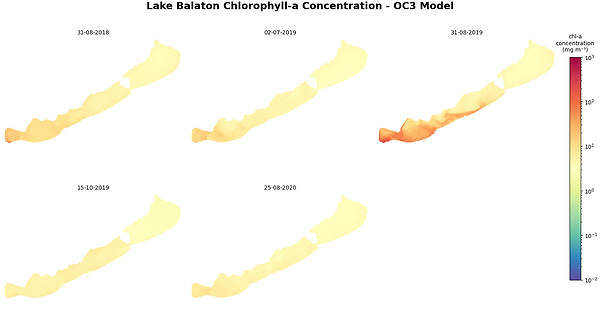
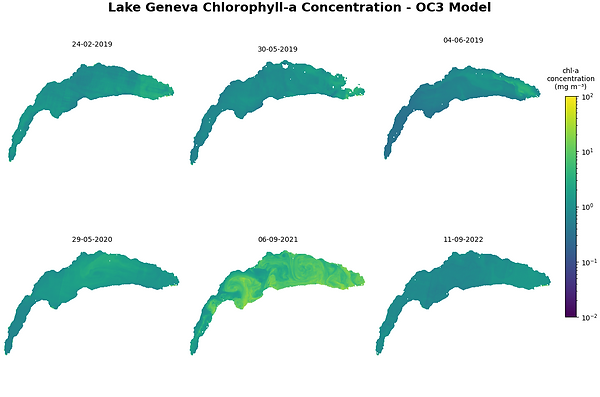
Here, the results from the OC3 model, which performed the best in both lakes, are presented. The model highlighted the algal bloom events that occurred in each lake and the bloom's dispersal.
Conclusions & outlook
Monitoring the water quality, and particularly the distribution of phytoplankton, of inland waters is crucial to sustaining the ecosystem’s health and human activities that depend on clean water. Earth observation satellites provide frequent observations with large spatial coverage and can assist in analyzing the conditions of inland water bodies, in contrast to traditional sampling methods that are limited in space and time. This study utilized Sentinel-2 MSI satellite data to compare different chl-a concentration models in Lake Balaton and Lake Geneva. The Sentinel-2 data were atmospherically corrected with ACOLITE and C2RCC, two processors that have been previously used in similar lake environments. Although the Sentinel-2 mission was mainly designed for land applications, Sentinel-2 MSI data proved useful for monitoring the water quality of the lakes. The OC2, OC3, and MDN models were successfully applied to the satellite imagery to detect and monitor the chl-a concentration of the two lakes. The combination of the selected models for these two specific lakes has not been extensively studied in the past. Additionally, in-situ measured Rrs and chl-a concentration data were retrieved for each lake to assess the performance of the AC processors and chl-a models, respectively. Among the selected dates, two algal bloom events were included (one for each lake), which the models were able to detect. ACOLITE generally achieved moderate accuracy, performing better for the 490 nm and 560 nm bands than for the 443 nm and 665nm bands. C2RCC showed overall good accuracy for all bands and achieved the best results for the blue (490 nm) band. Even though the accuracy of the chl-a concentration models varied, they were able to capture the spatial distribution and the changes in concentration among the different selected dates, even if the absolute concentration values differed from the in-situ measurements. The best overall performance was achieved by the OC3 model in both lakes, while MDN also provided promising results.
Future studies could test the applicability of the ACOLITE processor for Lake Geneva and of C2RCC for Lake Balaton and perform a comparison of the results. Additionally, the same approach described in this study could be tested for more recent satellite imagery and in-situ data to validate the chl-a models. Furthermore, the existing chl-a concentration models could be compared against locally trained ones, especially since studies have suggested that locally trained models usually outperform globally trained ones. It would be particularly useful to test re-training the MDN model with data from Lake Balaton and Geneva, to determine whether the results improve for these two lakes without compromising the accuracy for other study areas. Lastly, the same methodology could be applied to Sentinel-3 OLCI data, which are specifically designed for water applications, to evaluate the performance of both the AC processors and the chl-a models and compare the results to those achieved with Sentinel-2 data.